
Rise Review:
Elevating UX Performance
The RISE Review is a comprehensive 360º review process I developed for the UX team. It aims to foster open communication and facilitate performance tracking and career development. This framework encompasses self-assessment, peer review, and manager calibration to evaluate performance across six key criteria: Popsicle, Problem-solving, Execution, Thought leadership, Leadership, and Presence.
Through this process, employees rate themselves and receive feedback from peers, culminating in a rating by the manager. The review feedback is shared with employees, along with Objectives and Key Results (OKRs) for continued development.
Introducing this concept to my team allowed for regular personal reflection and feedback, which served as the foundation for designing individual career growth plans. This initiative cultivated trust and commitment among team members. As a result, other teams within the company recognized the value of this framework, prompting the adoption of this review process. With a 100% retention rate and notably high job satisfaction, this feedback mechanism significantly contributed to the success and cohesion of the team.
Role: Sr. Director, User Experience
Timeframe: 2020
Rise Review Framework
Introduction
Set the stage by explaining the purpose and structure of the review process.
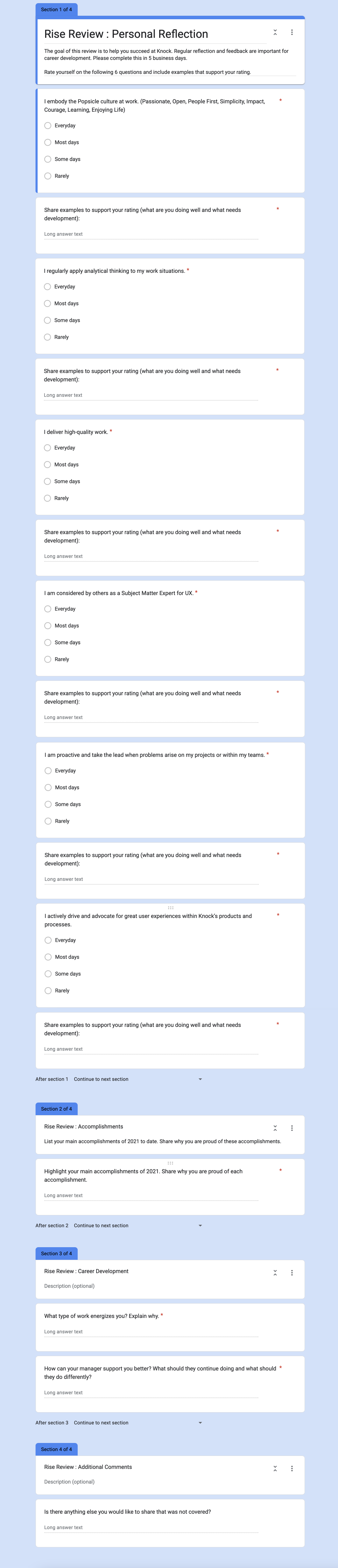
Self-assessment
Employees rate themselves on six criteria: Popsicle, Problem-solving, Execution, Thought leadership, Leadership, and Presence.
Four grades are used: “Every day,” “Often,” “Sometimes,” and “Rarely.”
Employees provide examples supporting their ratings and highlight their main accomplishments for the last cycle.
Reviewer Selection
Employee suggests a shortlist of reviewers.
Manager and employee discuss and validate the shortlist, considering proximity to contributions and ability to assess performance.
Peer 360 Feedback
Peers provide feedback in three categories: strengths, weaknesses, and ratings on the six criteria.
Peers comment on the reviewee’s contributions to specific projects.
Calibration
The manager drafts a rating based on self-reviews, peer reviews, and overall performance.
Ratings include “Needs Improvement,” “Consistently Meets Expectations,” “Exceeds Expectations,” “Strongly Exceeds Expectations,” and “Superb.”
Share Review Feedback
The manager shares feedback with the employee.
Establish OKRs (Objectives and Key Results) or goals for 30/60/90-day check-ins to drive improvement and development.
Follow-up
Schedule follow-up meetings to track progress on OKRs and goals.
Provide support and resources as needed to help employees meet expectations and exceed goals.
This framework ensures a thorough review process that integrates self-assessment, peer feedback, and managerial evaluation. This process focuses on setting clear goals for future development and performance improvement. In the absence of a companywide review process, other teams within my company have adopted this framework for their reviews.
Rise Review Self Assessment
Rise Review Peer Assessment
